How to Reduce Customer Waiting Times Without Hiring More Staff
The Sedia team · · 9 min read

When a queue grows, hiring another person can look like the only answer. Sometimes more capacity is needed, but first check how customers arrive, where work pauses and whether the staff you already have are available at the right moment. A busy team can still lose time to bunching, repeated data entry and two lists that do not agree.
To reduce customer waiting times without hiring more staff, smooth arrivals, manage bookings and walk-ins in one flow, collect necessary information before service and move existing capacity to the peak. Give customers a realistic wait range and let them wait elsewhere. Then measure arrival, service-start and completion times so you fix the stage that is actually causing the delay.
Why do customer queues grow so quickly?
A queue forms when arrivals temporarily exceed the rate at which the business can begin or complete service. The daily totals can look balanced while the morning clinic rush, the after-work salon period or a Saturday workshop intake still produces a long line.
Two queueing principles explain why.
Little's Law links the average number of customers in a stable system to the arrival rate and the average time each customer spends there: number in the system = arrival rate × time in the system. John D. C. Little published the proof in 1961 (Little, 1961). The boundary can cover waiting alone or the whole visit, but the measurements must use the same boundary.
J. F. C. Kingman's analysis of a single-server queue in heavy traffic showed that equilibrium waiting becomes large as traffic intensity approaches full utilisation, under fairly weak conditions (Kingman, 1962). The practical lesson is not to keep staff idle. It is to preserve a little room for clustered arrivals, long jobs and ordinary disruption instead of planning every minute at the average.
Our guide to the economics of queues explains these relationships in more detail. For reducing today's wait, use them as a way to choose the right lever.
What can you change before adding more staff?
Start with changes that alter the timing or remove work from the critical service path. The best choice depends on whether your queue is caused by arrivals, preparation, the service itself or the handover between stages.
| Lever | Sign that it may help | Practical first change |
|---|---|---|
| Shape arrivals | Many customers arrive in the same short period | Offer staggered slots or different collection windows |
| Combine bookings and walk-ins | Staff reconcile an appointment diary with a separate queue | Put checked-in bookings and walk-ins in one working list |
| Prepare before arrival | The first minutes repeat predictable questions or checks | Collect only the necessary details through a short form |
| Enable remote waiting | People remain on site mainly to protect their place | Give each customer a live ticket and a clear return rule |
| Improve wait information | Staff repeatedly answer “How long?” | Show a realistic range and refresh it as the line changes |
| Re-time existing capacity | Administrative work or breaks overlap the busiest period | Move flexible work outside the measured peak |
| Measure each stage | Everyone is busy, but the cause is unclear | Record join, service-start and completion times |
How can you shape arrivals without turning everyone away?
Do not try to force every customer into a booking. Give flexible customers a reason to choose a quieter time while preserving a walk-in route for people who need it.
A clinic can release appointments at staggered times rather than giving several patients the same start time. A repair shop in Ubi can offer separate morning drop-off windows. A salon can keep some space for walk-ins between bookings rather than filling the diary edge to edge.
Watch for displacement. Moving all demand from one peak into a new half-hour does not solve the problem. Compare arrivals in short intervals and adjust one window at a time.
How should bookings and walk-ins share one queue?
Bookings and walk-ins need different promises before arrival, but they should become one visible operating flow after check-in. Staff can then see who is present, which service they need and what priority rule applies.
Write down that rule. For example, a checked-in booking may keep priority around its slot while a late arrival enters the current flow. Urgent cases may move ahead in a clinic, and a restaurant may match a small party to an available table without serving every party strictly by arrival time. The rule should fit the service and be easy for staff to apply consistently.
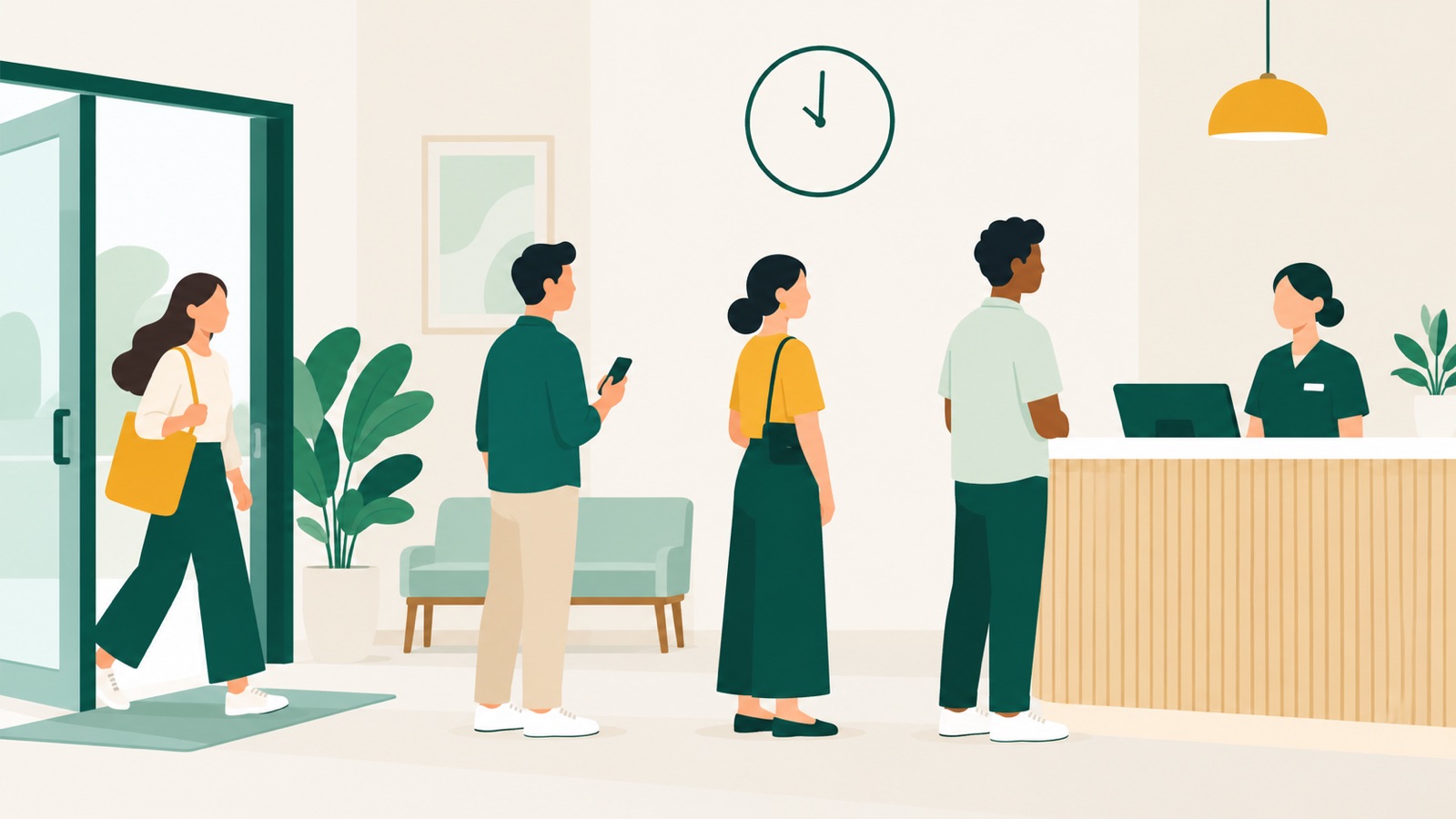
One list also prevents duplicated work. If reception checks the booking diary, copies a name to a paper sheet and later updates another screen, the customer is waiting while the same visit is entered three times. Our overview of how a queue management system works shows how joining, calling and reporting fit together.
What information should you collect before service?
Move predictable questions earlier, but keep the form short. Ask only for details that change how the visit is prepared or routed: the service needed, party size, vehicle type or a brief reason for the visit may be enough, depending on the business.
Use the answers before the customer reaches the counter. Prepare a file, assign the right chair, identify the suitable bay or flag that a longer consultation may be needed. A form that nobody reviews simply moves waiting from the counter to the customer's phone.
In Singapore, the PDPC says organisations should collect and use personal data only for an appropriate, notified purpose, and stop retaining it when it is no longer needed for that purpose or for legal or business reasons (PDPC, 2021). Avoid turning queue registration into a general customer profile when the visit does not require one.
Can remote waiting reduce the actual wait?
Remote waiting does not by itself make service faster. It lets the customer leave the immediate waiting area while keeping track of their place, rather than standing near the counter or asking staff for an update.
Give the customer a confirmed place, a live status and a clear instruction about when to return. A customer waiting at a nearby coffee shop in Tampines needs to know whether “your turn is soon” means two minutes or fifteen. Keep an assisted route for someone without a suitable phone, and make sure both routes feed the same queue.
How should you give an honest wait estimate?
Use a range rather than a single promise. A range acknowledges that the next service may take longer than average, while still giving the customer something useful for deciding whether to stay nearby.
Review the estimate as the day changes. New arrivals, no-shows, urgent work and a job that runs long can all make the earlier estimate stale. If the operation is disrupted, explain that plainly rather than leaving an old estimate on display.
An estimate should be checked against the actual waits that followed it. If the displayed range is regularly too short at lunch or too long near closing, change the underlying operating window or the way the range is set.
How can you schedule the same team around peaks?
Measure the peak before moving people. “Mornings are busy” is too broad if the queue actually forms from 8.20 am to 9.00 am, or only when registration and phone enquiries are handled by the same person.
Once the period is clear, move flexible tasks around it. Finish opening checks before the first arrival cluster, stagger breaks, do stock work later or let a trained back-office colleague open a second service position for the short peak. Keep handovers simple so the extra movement does not create another delay.

Do not run every hour at full utilisation. The queueing result above explains why a small amount of spare capacity can protect the flow when arrivals or service times vary.
How do you measure whether waiting time is improving?
Choose consistent timestamps for each visit:
- arrival, if it differs from joining;
- queue join or booking check-in;
- service start;
- service end; and
- cancellation, departure or no-show where relevant.
From these, separate wait time from service time. Look at both typical waits and the longest waits, because a lower average can hide a small group of very poor experiences. Break results down by service and useful operating window rather than comparing one whole month with another.
Little's Law also gives you a reasonableness check. In an illustrative stable period, suppose eight customers arrive each hour and spend an average of 45 minutes from joining to completion. The average number in the system is 8 × 0.75 = 6 customers. If the same throughput is maintained while time in the system falls to 30 minutes, the average becomes 8 × 0.5 = 4 customers. This is example arithmetic, not a benchmark or a promised result.
Test one operational change at a time for comparable periods. Record what changed, allow for unusual days and check whether the result held for customers as well as staff. If wait time falls but service time or no-shows rise, investigate before making the change permanent.
What is a practical 30-day plan?
Week 1: observe the flow
Define when waiting starts and ends. Record arrivals, service starts and completions in short time windows. Ask staff where they repeat work or switch between lists.
Week 2: remove one avoidable delay
Choose a short pre-arrival form, one combined queue or a clearer check-in rule. Do not change several parts at once, or you will not know which one helped.
Week 3: adjust the peak
Move one flexible task, break or staff duty away from the measured arrival cluster. Keep enough capacity available for normal variation.
Week 4: improve the waiting experience
Introduce a wait range, status update or remote-waiting option. Compare the quoted range with actual waits and correct it when it drifts.
Frequently asked questions
Can waiting times be reduced without making service faster?
Yes. You can reduce delays before service by smoothing arrivals, collecting information earlier, removing duplicate entry and matching customers to the right resource. Remote waiting may not shorten the clock time, but it gives the customer more control over it.
Should every walk-in business add appointments?
No. Appointments help when some demand is predictable and customers can choose a time. A pure walk-in model may suit short, highly variable services better. Many businesses need a mixture, with both routes managed in one current list.
Is an exact wait time better than a range?
Usually a range is more honest for a variable service. It can still support a decision without pretending that every consultation, haircut, table turn or repair takes the same time.
Which queue metric should you start with?
Start with wait time from confirmed join or check-in to service start, then record service time separately. Add arrivals by time window, no-shows and unusually long waits once those timestamps are reliable.
How will Sedia help reduce customer waiting times?
Sedia is a pre-launch queue and booking system for Singapore businesses. Planned features include a live ticket for customers and one staff list for walk-ins and checked-in bookings. On Essentials and above, wait estimates will show a range based on the business's own past service times and update as the day's line moves. Analytics will cover wait time, service time, no-shows and busy hours.
You can review the planned features and register your interest to hear when Sedia is ready.
Sources
- John D. C. Little, “A Proof for the Queuing Formula: L = λW”, Operations Research, 1961.
- J. F. C. Kingman, “On Queues in Heavy Traffic”, Journal of the Royal Statistical Society: Series B, 1962.
- Personal Data Protection Commission Singapore, “Data Protection Obligations under the Personal Data Protection Act”, 2021.