The economics of queues: what waiting really costs your business
The Sedia team · · 7 min read
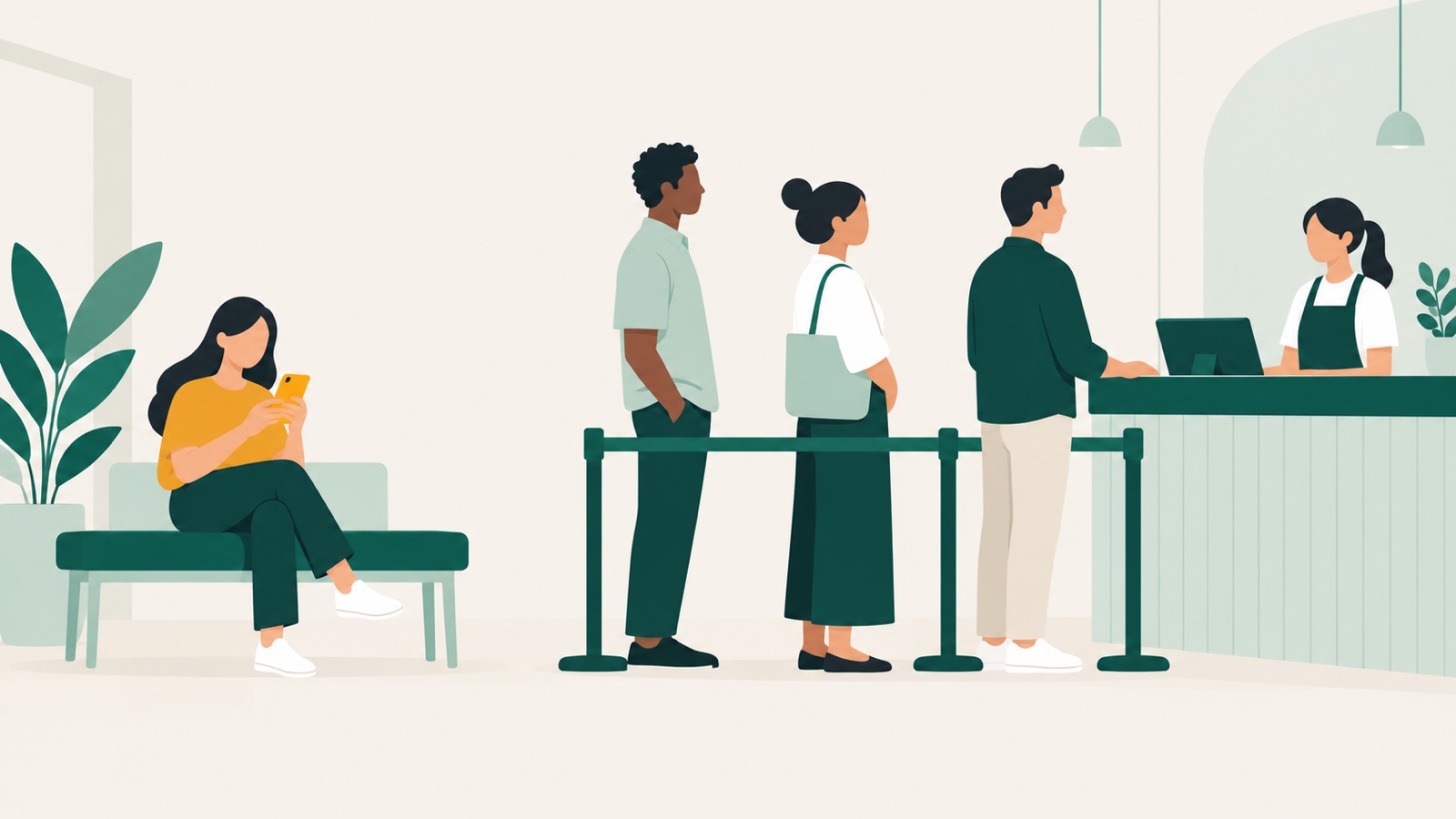
A queue is not merely a line of people. It is inventory made of customers’ time. While a customer waits, the business has not yet delivered the service, the customer cannot fully use that time elsewhere, and both sides carry the risk that the transaction never happens. That makes waiting an economic issue as much as a customer-service issue.
Every queue is a capacity decision
Queues form when demand and service capacity do not match from moment to moment. A clinic may have enough consultation capacity across a day but still face a rush after lunch. A salon appointment may run long. A restaurant may receive several parties together. A workshop may discover that one job needs more diagnosis than expected.
The obvious response is to add capacity. Sometimes that is correct, but capacity has a cost even when idle. Another staff member, chair, treatment room or service bay may shorten waits, yet it must be paid for during quiet periods too. The management problem is therefore not “How do we eliminate all waiting?” It is “What balance of waiting, capacity and service level makes sense for this business?”
Running every resource at maximum utilisation is rarely that balance. In a single-server queue, J. F. C. Kingman showed that equilibrium waiting becomes large as traffic intensity approaches full utilisation under broad conditions (Kingman, 1962). In plain language, the last bit of spare capacity is valuable: it absorbs late arrivals, longer jobs and ordinary disruption. Once that cushion disappears, a small disturbance can leave work accumulating faster than it clears.
This is why a team can look busy all day and still produce a poor customer experience. Busyness measures resource use; it does not measure flow.
Little’s Law makes waiting visible
One of queueing theory’s most useful relationships is Little’s Law:
Average number in the system = average arrival rate × average time in the system
John D. C. Little proved this relationship for a stationary queueing process in 1961 (Little, 1961). “In the system” can mean waiting plus service, or the boundary can be drawn around the waiting line alone, as long as the measurements use the same boundary and a stable period.
Consider an illustrative example. Imagine a clinic accepting an average of six patients per hour during a stable session. If patients spend an average of half an hour from joining the queue to leaving, the average number in the system is:
6 patients per hour × 0.5 hours = 3 patients
This is not an industry benchmark; it is simply arithmetic showing how the law works. If throughput stays at six patients per hour but time in the system rises, the number of patients present must rise too. Conversely, reducing time in the system reduces congestion without requiring fewer completed visits.
For managers, the practical lesson is to measure three things together:
- how many customers enter the system;
- how many are waiting or being served; and
- how long they spend waiting and in service.
A daily average can conceal the period that matters. Break the data into useful operating windows—such as weekday lunch, Saturday morning or the final hour before closing—then compare similar windows over time.
Variability creates the queue
Averages alone do not describe a service operation. Two salons may both average the same number of customers and the same service time, yet experience very different waits. One may have evenly spaced arrivals and consistent jobs. The other may receive customers in clusters and handle a mix of quick trims and complex treatments.
Kingman’s heavy-traffic work connects waiting not only to utilisation but also to variation in arrival and service times (Kingman, 1962). Operationally, this gives managers three levers:
- Shape arrivals. Use bookings, staggered start times or different collection windows to reduce bunching where customers have flexibility.
- Reduce service variation. Gather information before service, prepare common items in advance and route unusually complex work appropriately.
- Protect capacity at peaks. Schedule breaks, administrative work and flexible staff with the demand pattern in mind.
Do not confuse variation with staff failure. A vet cannot make every consultation identical, and a mechanic cannot know every fault before inspection. The aim is to identify predictable sources of variation and design enough flexibility around them.
Waiting can erase demand before it appears in sales
Queueing researchers distinguish between balking, when someone sees the queue and decides not to join, and reneging, when someone joins but leaves before being served (Wang et al., 2014). Both matter because neither looks like an ordinary lost sale.
A person who walks past a crowded entrance may never enter the customer record. Someone who leaves quietly may be marked as absent rather than dissatisfied. Revenue reports alone therefore understate the demand that the operation could not convert.
Useful measures include:
- joins by time of day;
- completed service, cancellations and no-shows;
- customers who leave after joining;
- quoted or displayed wait versus actual wait; and
- occasions when staff stop accepting walk-ins.
These measures will not reveal every person who chose not to join, but they make hidden loss more visible. Staff observations matter too: “people often turn away when all seats are occupied” is a hypothesis worth testing, not a statistic to repeat as fact.
The same wait can feel very different
Clock time is only one part of waiting. David Maister’s 1985 essay on waiting lines proposed that occupied waits feel shorter than unoccupied waits, uncertain waits feel longer than known finite waits, unexplained waits feel longer than explained waits, and unfair waits feel longer than equitable waits (Maister, 1985).
These ideas translate into simple operating choices:
- acknowledge the customer and confirm that they have joined successfully;
- give a realistic indication of progress rather than a vague promise;
- explain unusual delays plainly;
- make the service order understandable; and
- let customers use their waiting time away from the premises when possible.
Information does not create capacity, but it reduces uncertainty. Fairness also needs care when bookings and walk-ins share an operation. Customers do not need every scheduling rule, but they should be able to understand why the visible order may differ from the service order.
Improve the system before buying more capacity
When waits are poor, work through the causes in sequence.
Define the queue
Choose clear start and end points. Does waiting begin when a customer arrives, checks in or completes a form? Does it end when their name is called or when service actually begins? Consistent definitions make comparisons meaningful.
Find the constraint
Observe where work accumulates. The bottleneck may be registration, a particular practitioner, payment or room turnover. Adding capacity somewhere else may only move the queue.
Separate demand, service and delay
Record arrival times, service-start times and service-end times. This separates waiting from the work itself and shows whether the problem is bunching, insufficient peak capacity, long service, or high variability.
Test one change at a time
Try a revised booking interval, a peak-hours role change or an earlier information-collection step. Compare like-for-like periods and watch both average performance and unusually long waits. Averages can improve while a few customers still experience a serious delay.
Make the queue useful to customers and managers
A good queue system should do two jobs: coordinate customers now and produce evidence for better decisions later. Sedia combines walk-ins and bookings in one queue. Customers can join by QR code or link without an app or account, see their live place on their phone, and receive a message when they are nearly up. Businesses can use wait estimates based on their own history and show the queue on a TV display. Sedia can also list the business in a directory that AI assistants can query.
Technology does not repeal queueing economics. It makes the system observable and gives customers more control over otherwise wasted time. The goal is not an empty waiting area at any cost. It is a flow that protects customer time, uses capacity sensibly and converts more genuine demand into completed service.
Sources
- John D. C. Little, “A Proof for the Queuing Formula: L = λW”, Operations Research, 1961.
- J. F. C. Kingman, “On Queues in Heavy Traffic”, Journal of the Royal Statistical Society: Series B, 1962.
- David Maister, “The Psychology of Waiting Lines”, 1985.
- Yibing Wang, Jingqiu Guo, Avishai Ceder, Graham Currie, Wei Dong and Hao Yuan, “Waiting for public transport services: Queueing analysis with balking and reneging behaviors of impatient passengers”, Transportation Research Part B, 2014.