How Much Does a Queue Management System Cost in Singapore?
The Sedia team · · 9 min read

A queue management system can be a QR code and a browser tab, or a full counter setup with a kiosk, ticket printer and television. Those two versions should not share one headline price.
The short answer: start with the software, then add the cost of locations, messages, equipment, setup and tax. For a fair comparison, price the first year for the same workflow and customer volume, not only the subscription shown on the pricing page.
How much does queue management software cost per month?
There is no dependable single market average because, as our Singapore queue-system comparison shows, suppliers count different things. One plan may charge per location, another may limit staff accounts, and another may quote the whole deployment.
The public examples below are as listed on the suppliers' websites in October 2026. They are not like-for-like, and prices may exclude GST, currency conversion, hardware and optional services.
| Supplier | Public software price | What changes the bill |
|---|---|---|
| Sedia (pre-launch) | Free; Essentials S$39 per location monthly or S$32 a month billed annually; Pro S$199 monthly or S$166 billed annually; Custom from S$499 | Visits, plan, locations and prepaid WhatsApp or SMS credits |
| WaitQ | Its Singapore guide lists Starter at S$36 a month billed annually | Locations, staff accounts and notification allowance |
| OneWayQueue | S$50 a month, billed quarterly | One QR code per location, plus S$0.04 for each WhatsApp message; the supplier says each queue number receives at least two messages |
| Qwaiting | US$249 monthly or US$2,490 yearly for Starter | Plan, staff logins, SMS, configuration and enterprise features |
This table shows why “from S$36 a month” is not a full budget. A cheaper subscription can cost more after messages, while a dearer plan may include an allowance that covers normal use.
What makes up the total cost of a queue system?
1. Software subscription
Start with the plan that supports the job you need now. Check whether bookings, wait estimates, reporting, languages and your own branding are included. Annual billing may lower the monthly equivalent, but it also brings forward a year's payment and reduces your freedom to change.
2. Locations, counters and staff
“Per location” is not the same as “per company”. A clinic group with three branches may need three subscriptions even if one manager oversees them all.
Then check how the supplier defines a counter or resource. A resource might be a doctor, barber chair, table, room or service desk. Suppliers such as WaitQ and Qwaiting set plan limits for staff accounts. List every person and physical point used during the busiest shift, including a spare counter that opens only at lunch.
3. Kiosk, printer and television
A QR-first queue can run on customer phones and an existing staff computer. Dedicated equipment is optional for many small operations, but it becomes useful when you need a fixed check-in point, printed tickets or a large public display.
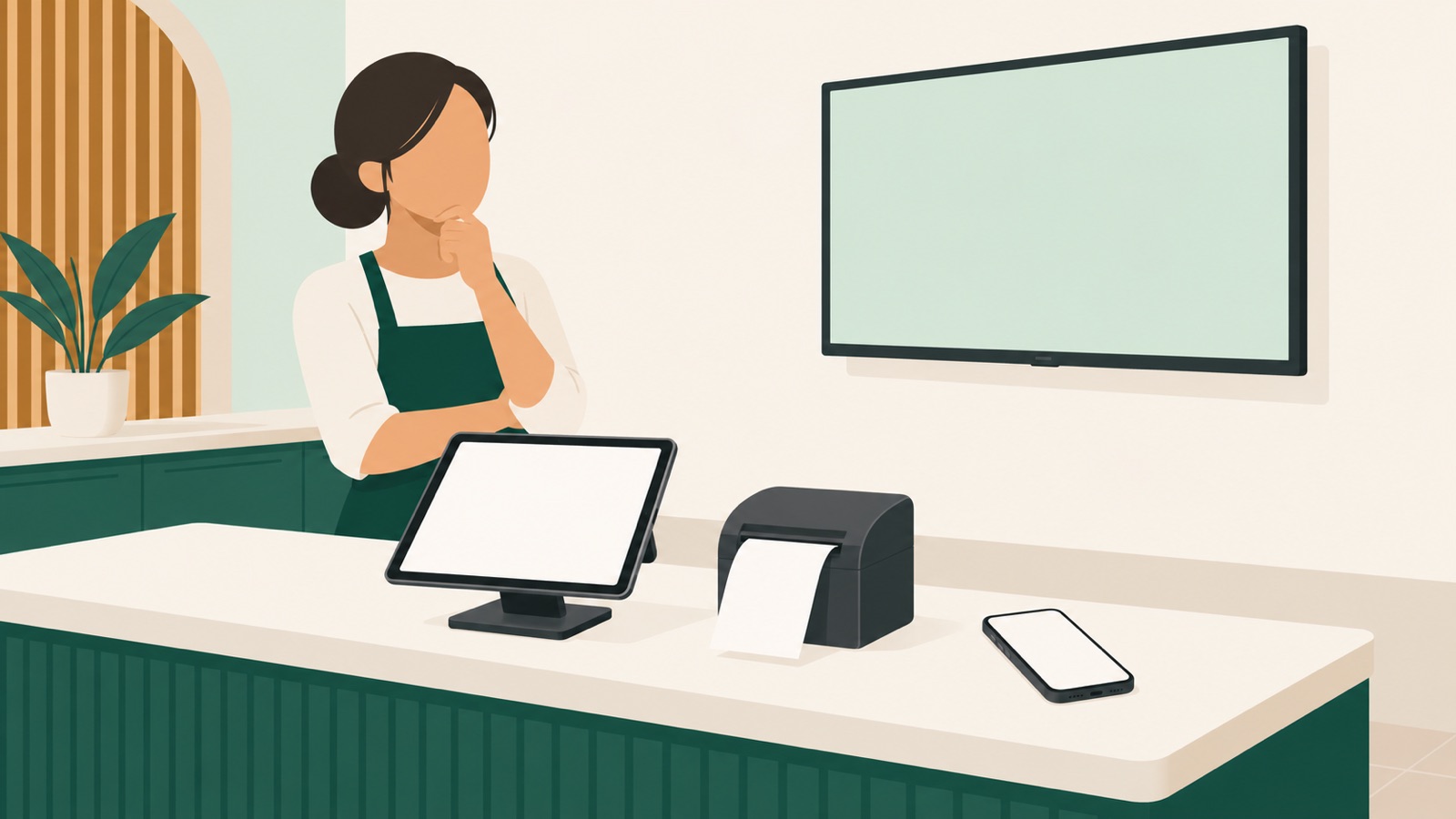
Treat the device, secure stand, cabling, wall mounting and installation as separate lines. A “kiosk” price may cover only the enclosure, not the tablet inside it.
4. SMS and WhatsApp messages
Do not budget messages from the subscription alone. Count how many messages one visit creates. A confirmation, “nearly your turn” alert and final call are three messages, not one.
OneWayQueue publishes S$0.04 per WhatsApp message and says each queue number receives at least two, so 1,000 queue numbers would produce at least S$80 in message charges. Sedia's planned pricing uses a S$50 pack of 1,000 credits: one WhatsApp message uses one credit and one SMS uses two.
If web push or email is included in a plan, test whether customers notice it during a busy shift before treating it as a substitute for paid messages.
5. Setup, training and support
Self-service software may have no separate installation charge. OneWayQueue, for example, states that no installation is required. A managed system may instead quote configuration, data import, on-site installation, training or a support contract.
Ask for each item in writing. “Setup included” should say how many locations, training sessions and hours of configuration are covered. Also budget staff time for mapping the queue, testing exceptions and rehearsing the new process.
6. Consumables, tax and contract terms
Printed tickets create an ongoing paper or label cost. Add GST where applicable, and convert foreign currency using the rate you will actually pay. Check the minimum term, renewal date, cancellation notice and whether unused message credits expire.
How much can queue hardware add?
These public Singapore prices show the order of magnitude. They are an illustrative shopping basket, not a compatibility recommendation. Confirm every device with the queue-software supplier before buying it.
| Item | Public price checked in October 2026 | Budget note |
|---|---|---|
| Entry Apple iPad, Wi-Fi, 128 GB | S$649 | Tablet only |
| Lockable Bosstab Elite Evo floor stand | from S$369.95 | Holder and stand; options can raise the price |
| Brother QL-800 direct-thermal label printer | S$281 | USB model; software compatibility must be confirmed |
| Brother DK-11201 labels, 400 per roll | S$20.20 | An example recurring consumable |
| Samsung 43-inch Q5F television | S$549 recommended retail price | Wall mount and installation are not included |
The tablet and secure floor stand alone total S$1,018.95. Adding the sample printer and television takes the equipment subtotal to S$1,848.95 before labels, mounting, cabling or installation.
Can a small business start without a kiosk or printer?
Yes. If most customers have a phone, begin with a QR code or link, a staff browser and a clear staff-assisted fallback. Use an existing television only if customers need to see the queue while they remain nearby.

Add a kiosk when a fixed, accessible check-in point solves a real problem. Add a printer when enough customers need paper tickets to justify the device, integration and consumables. Our broader Singapore queue-system guide explains the main system types and when each is useful.
What is an example budget for a small clinic?
This example is illustrative, not a quote. Assume one neighbourhood clinic needs simple appointments and a walk-in queue, expects no more than 1,500 visits a month, wants a floor kiosk, printed tickets, a waiting-room display and one 1,000-credit message pack. It uses Sedia's planned Essentials monthly price and the public hardware above.
| Clinic cost | Amount |
|---|---|
| Sedia Essentials, one month | S$39.00 |
| One 1,000-credit message pack | S$50.00 |
| iPad and lockable floor stand | S$1,018.95 |
| Label printer | S$281.00 |
| Three rolls of 400 labels | S$60.60 |
| 43-inch television | S$549.00 |
| Illustrative first-month total | S$1,998.55 before GST |
If the clinic buys one message pack and three label rolls in a later month, the illustrative recurring total is S$149.60 before GST. Real message use may be higher or lower. The budget excludes mounting, installation, internet, spare equipment and staff time, and it assumes the chosen printer is supported.
What is an example budget for a small café?
Assume a café in Toa Payoh has one location, fewer than 1,500 visits a month, an existing laptop and no need for printed tickets or a public display. Customers join from a QR code and receive the web push or email notifications included in Sedia Essentials.
| Café cost | Amount |
|---|---|
| Sedia Essentials, one month | S$39.00 |
| Existing laptop and customer phones | S$0 new hardware |
| Optional paid messages | S$0; none bought in this example |
| Self-setup | S$0; no supplier service bought in this example |
| Illustrative first-month total | S$39.00 before GST |
This is deliberately lean. If customers miss browser alerts, the café could add a message pack. If staff spend too much time helping people join, it could add a kiosk later. That sequence avoids buying hardware before the need is proven.
Can a Singapore government grant pay for a queue system?
The Productivity Solutions Grant is no longer open for new applications. Enterprise Singapore says PSG ceased on 29 September 2026, with applications moving to the EDGE Grant from 30 September. The EDGE page states support of up to 70% for SMEs and up to 50% for non-SMEs, depending on the activity, and says claims are reimbursed after the activity is completed and paid for.
We could not verify that a queue management system is currently a supported EDGE activity. Do not deduct a grant from your budget until the official activity page or BizSG adviser confirms the exact product and costs. Enterprise Singapore's EDGE FAQ says an application is retrospective if work starts or any payment or deposit is made before submission.
How should you compare queue-system quotes?
Ask every supplier to price the same normal month, busy month and first year. Include:
- every location, counter, room, table or staff account;
- normal and peak visit volumes;
- the number and type of messages per visit;
- kiosk tablets, enclosures, printers, displays and consumables;
- setup, training, data import, integrations and support;
- GST, foreign-exchange costs and annual prepayment; and
- replacement hardware and the process when a device or internet connection fails.
Then test the flow before committing. The cheapest system is expensive if staff work around it or customers cannot use it. The Sedia features page gives a practical list of join, waiting, serving and reporting functions to take into a comparison.
Frequently asked questions
What is the cheapest way to set up a digital queue?
Use a cloud plan, QR code, existing staff computer and customer phones. Start without a kiosk, printer or television, then add hardware only where a live pilot shows it is needed.
Is queue hardware normally included in the monthly fee?
Do not assume so. Ask for an itemised quote covering tablets, stands, printers, televisions, mounts and installation, and confirm who owns, supports and replaces each device.
How should I estimate WhatsApp or SMS costs?
Multiply monthly visits by the messages sent per visit, then apply the supplier's channel rate or credit rules. Allow for reminders, final calls, retries and appointments as well as walk-ins.
Should I choose annual billing to save money?
Only after a live pilot. Annual billing can lower the monthly equivalent, but a short monthly term is often worth more while you are still proving the workflow, message volume and staff adoption.
Sedia is a pre-launch queue and booking system for Singapore clinics, cafés, salons, restaurants, vets and workshops. Its planned Essentials plan is S$39 per location monthly or S$32 a month billed annually. You can register your interest to hear when it is ready.
Sources
- Sedia pricing
- WaitQ pricing and Singapore pricing guide
- OneWayQueue features and pricing
- Qwaiting pricing
- Apple Singapore iPad store
- Bosstab Singapore Elite Evo floor stand
- Brother Singapore QL-800 printer and DK-11201 labels
- Samsung Singapore Q5F television pricing
- Enterprise Singapore: PSG closure, EDGE Grant and EDGE FAQ